By Daniel Heider
In Washington, DC, the club landscape is to some degree shaped by the region’s patchwork of jurisdictions. In a city where neighborhoods are distinct and expectations are highly localized, clubs function as stabilizers. They give members consistent access to courts while consolidating social life through golf, tennis, and dining.
The region’s best country and racquet clubs are built on membership caps, committee structures, and facility limits, forming the unique landscape which we’ve outlined below. Read on to explore clubs and learn about their membership benefits, waitlists, and connection to life in DC.
Key Takeaways
- Membership benefits to expect
- Examples of racquet-centric clubs
- What waitlists mean
- How to evaluate clubs
Membership Benefits That Actually Matter
In Washington, the real benefit of membership is control over routine that holds steady when schedules tighten and public inventory compresses. Members may expect:
- Predictable court access that accommodates early-morning and after-work play, reducing last-minute scheduling.
- Juniors programming with structure — coaching, ladders, and progression that reads as development, not supervision.
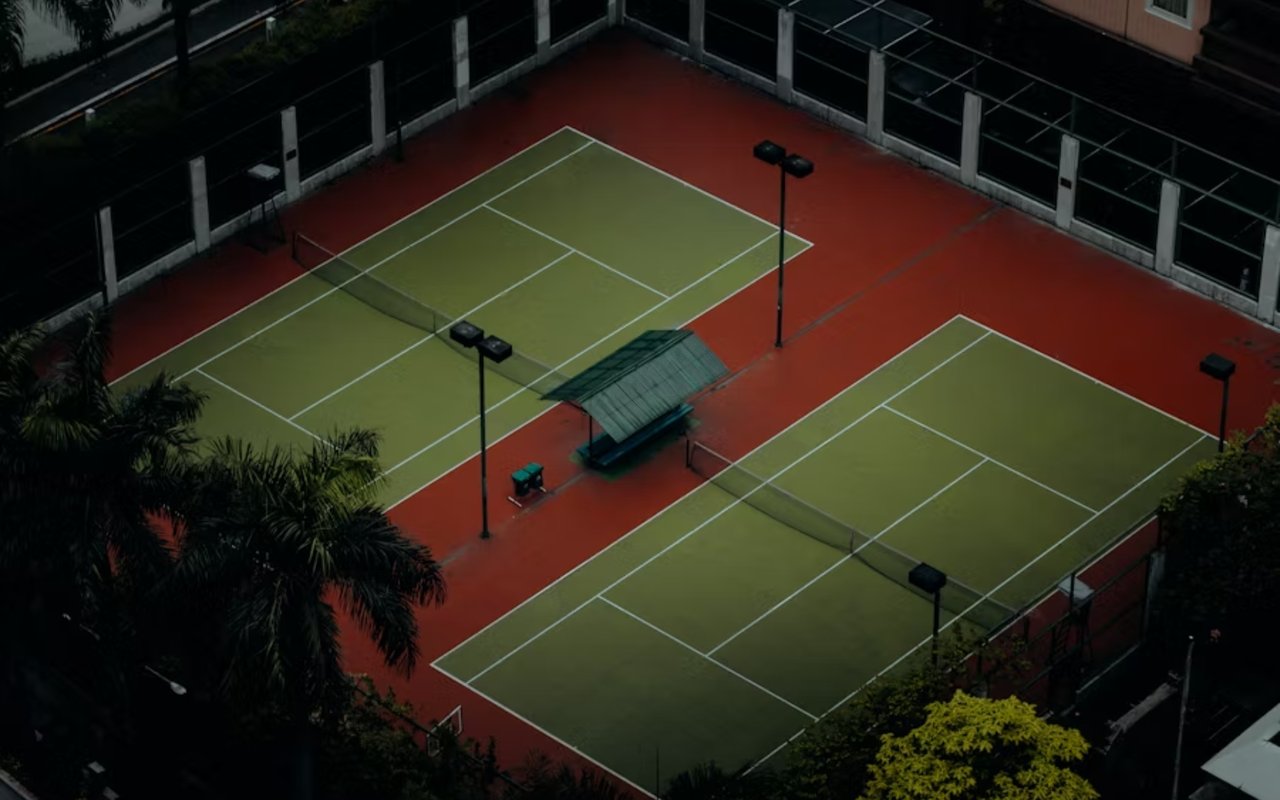
- Year-round racquet continuity through multiple formats and surfaces (platform tennis, paddle, pickleball, indoor options) that keep play consistent across seasons.
- Social and dining spaces that function as extensions of daily life, composed enough for regular use, private enough to feel dependable.
The strongest clubs in this region deliver value through extensive racquet inventory (including a mixture of indoor and outdoor courts) and the skillful management of said inventory.
Country Clubs Where Racquet Sports Are Integral
In Greater DC, several private country clubs treat racquet sports as a core system rather than an auxiliary amenity.
- Army Navy Country Club (Arlington/Fairfax) reads like a campus more than a club. Its own membership materials emphasize the scale of the property and the breadth of racquet inventory, including outdoor courts, an indoor tennis center, and a junior training facility.
- Bethesda Country Club (Bethesda) is unusually explicit about racquet programming and surfaces, including multiple outdoor clay courts, indoor courts, and additional paddle and pickleball capacity. The indoor/outdoor dynamic matters most when the weather turns or calendars tighten.
- Washington Golf & Country Club (Arlington) trades heavily on history and institutional identity — “the Club of the Presidents” — and positions tennis as part of that continuity. Members participate in men’s singles ladders, doubles flights, and tournaments.
Clubs like these treat racquets less as recreation and more as an access-controlled utility that holds its value through consistency.
Racquet-Centered Clubs Where Tennis Is the Point
Not every serious racquet environment in Greater DC is organized around golf. Some are defined by tennis culture first.
- The Chevy Chase Club is a useful example of how Washington clubs integrate modern racquet demand. As pickleball has grown in prominence, the club has reallocated its inventory across formats (indoor tennis, platform tennis, and, yes, pickleball).
- Columbia Country Club (Chevy Chase, MD) has a long racquet identity in the near suburbs, having hosted tournaments and touring professionals for decades. The club’s racquet program is part of its institutional core, not a recent add-on.
In both cases, the point is the same: tennis is treated as an organizing principle: managed, protected, and kept usable across seasons.
What Waitlists Actually Reflect
In Washington, a waitlist is rarely only a popularity measure. More often, it reflects one of three realities:
- Land and surface limits. Courts are not easily added, particularly close-in. Clubs that already have indoor capacity, multiple surfaces, or adjacent programming flexibility can absorb demand more gracefully.
- Governance and pacing. Many clubs admit slowly by design. That pace protects culture and keeps utilization within tolerances. It is less “exclusive for effect” than “exclusive to preserve.”
- Neighborhood alignment. In DC, club membership is often evaluated through the same lens as housing decisions: does it fit with where you live and how you move? A club across the river can be perfect on paper and still fail operationally if weekday traffic makes court time unrealistic.
In other words, the list is usually a reflection of fixed infrastructure and disciplined management — not a marketing signal.
How to Read a Club Before You Apply
If you approach membership as a Washington decision — not an aspirational one — the evaluation becomes clearer.
- Look for integration: The best clubs feel inevitable within their setting. Programs, courts, and social spaces operate as a coherent system, not a list of amenities.
- Favor proportion over abundance: A smaller club that manages court access well can outperform a larger one with internal bottlenecks. Inventory matters, but management matters more.
- Treat process as a signal: Sponsorship requirements, committee review, and paced admissions are often proxies for stability. If the process feels arbitrary, the member experience often is too.
- Assess the commute like infrastructure: Washington time is structured by traffic and meetings. A club that requires heroic logistics becomes a weekend-only asset, which changes its real value.
The goal is not to join the most talked-about club, but to choose the one whose systems will remain usable and relevant within your daily Washington pattern.
FAQs
How do I start the membership process at the best country clubs in Washington DC?
The process typically begins with learning the club’s category options, sponsorship expectations, and application steps, then matching them to the lifestyle goal.
What should I ask during a club tour?
Ask about court and tee reservation windows, guest policies, dining minimums, and how the event calendar affects access. It also helps to understand the club’s weekly rhythm so the culture matches the pace of life in DC.
Does living closer to a club really matter?
Proximity tends to make it easier to use the club for short workouts, early court sessions, and weeknight dining. When the drive feels simple, the membership becomes a consistent habit rather than an occasional outing.
Contact Daniel Heider Today
Private clubs and racquet facilities in Greater DC are best understood as long-horizon utilities. They reduce uncertainty. They provide predictable access to courts and the community. They offer a version of leisure that does not require performance.
If private clubs and courts are part of the lifestyle you want in Washington, DC, reach out to me, Daniel Heider. I’ll help you connect membership priorities to the right neighborhoods and property types.
If private clubs and courts are part of the lifestyle you want in Washington, DC, reach out to me, Daniel Heider. I’ll help you connect membership priorities to the right neighborhoods and property types.