
By Daniel Heider
In high-end residential properties, wine collections are no longer treated as accessories but as integrated components of the home itself. Buyers increasingly evaluate storage conditions, spatial planning, and environmental control with the same scrutiny they apply to kitchens or primary suites.
In markets like Washington, DC (where historic townhomes, new construction condos, and large-scale renovations coexist), wine programs often reflect both architectural constraints and long-term investment thinking.
Key Takeaways
- Necessary protocols for climate control, vibration mitigation, and UV protection.
- Architectural materials and assemblies that define a contemporary, collection-ready environment.
- Modern tasting nooks, social placement strategies, and integrated inventory tech.
- The long-horizon equity of holding a legacy wine collection within your own private gates.
Wine Storage as Architecture
In the upper tier of residential real estate, wine collections are no longer treated as amenities. They are evaluated as permanent components of the home, subject to the same scrutiny as kitchens, primary suites, and structural systems.
Why this shift changes how cellars are designed
- Infrastructure mindset: Systems are treated as permanent, engineered assemblies rather than add-ons.
- Performance priority: Thermal stability, vapor control, and vibration mitigation become non-negotiable baselines.
- Architectural integration: Placement and detailing feel inevitable within the plan, not inserted for effect.
- Legibility to the market: Quality becomes immediately apparent to those who understand storage discipline.
In Washington, where historic townhouses, ground-up residences, and highly considered renovations coexist, wine storage often reveals how seriously a home has been conceived. The distinction lies not in scale, but in execution.
The Invisible Foundation: Thermal Precision, Vapor Seals, and Vibration Control
Learning how to set up a wine cellar starts with the invisible infrastructure. Thermal stability, vapor control, and vibration mitigation form the baseline; without them, even the most visually compelling cellar is functionally compromised.
Why structural hardening defines the gold standard
- Closed-cell spray foam: High-density insulation and a permanent vapor seal in a single application to prevent moisture migration.
- Dedicated cooling systems: Ducted split units that keep noisy mechanical components outside the cellar while maintaining steady conditions around 55°F and 65% humidity.
- Thermal-pane glass walls: UV-filtered, double-paned specifications that support light without compromising chemical stability.
- Pressure-treated 2x6 framing: Deeper wall cavities for thicker insulation layers, a priority for estates in Kalorama or Massachusetts Avenue Heights.
Homes that integrate wine correctly treat these systems as infrastructure rather than accessories. Cooling is isolated, insulation is engineered, and moisture is controlled with permanence rather than patchwork.
Architecture Before Display: Performance-First Materials and Restraint
The trend toward “wine as art” has moved collections from the dark corners of basements to primary social floors, often serving as a sculptural anchor near dining rooms or grand halls.
The hallmark features of the contemporary collection
- Metal racking systems: Matte black or brushed gold minimalism that keeps labels and provenance as the focal point.
- Vertical display walls: Backlit acrylic cradles that create a floating effect for prized acquisitions while maintaining legibility.
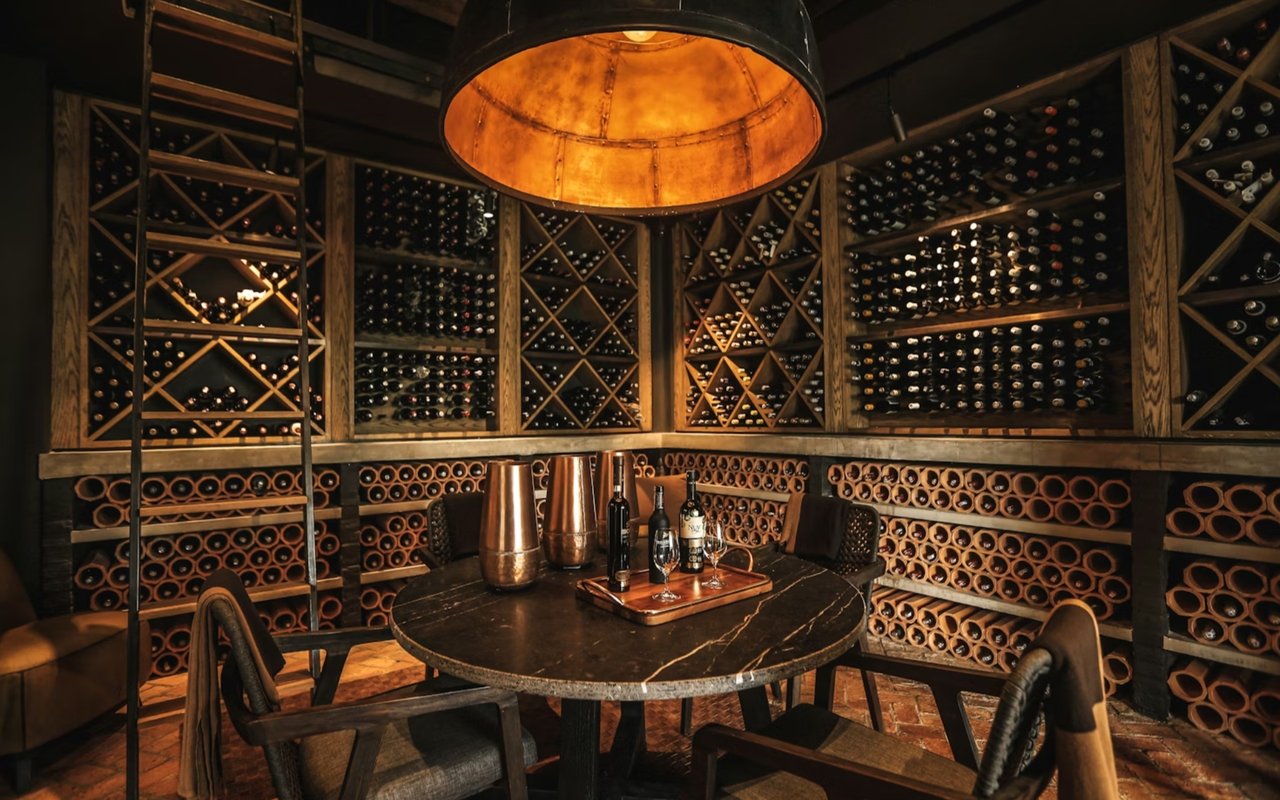
- Reclaimed French oak cabinetry: Warmth and craftsmanship that quietly nod to regional heritage and aging traditions.
- Stone and clay accents: Travertine or terracotta surfaces that help regulate humidity while shaping a composed, Mediterranean-style atmosphere.
The most resolved wine rooms, however, are conceived architecturally rather than decoratively, with materials selected for longevity before visual impact. Glass is specified for insulation and UV control, framing allows for depth and stability, and finishes respond to humidity rather than trend cycles. When display is introduced, it is restrained, allowing bottles to read as objects of provenance rather than ornament.
From Storage to Social Space: Positioning Wine in the Home’s Core
Increasingly, wine rooms are positioned within the social core of a residence, functioning as points of transition between dining, entertaining, and circulation. The goal is not performance, but daily integration—collecting as part of life rather than a concealed pursuit.
Social design cues that feel composed in DC homes
- Adjacency to dining: Direct relationship to formal or informal dining rooms for natural hosting flow.
- Tasting nook integration: A small table, banquette, or counter that supports opening and discussing bottles with ease.
- Circulation placement: Positioned along a primary route so the collection reads as architectural, not tucked away.
- Lighting discipline: Low-heat, low-glare lighting that supports label legibility without spectacle.
In Washington, where entertaining is often intimate and intentional, these spaces tend to be composed rather than theatrical. They invite use without requiring a staged moment.
Market Resilience and the Legacy Asset Advantage
For long-horizon owners, a properly designed wine cellar supports more than lifestyle. It protects value by keeping collections in controlled, purpose-built environments that avoid the risks and inconvenience of off-site storage.
Why holding a collection on-site strengthens long-term value
- Environmental consistency: A purpose-built envelope maintains stable conditions through heat, humidity shifts, and seasonal changes.
- Stewardship optics: A disciplined build signals care, planning, and a long-term view of ownership.
- Lifestyle continuity: The collection remains usable and present for entertaining, dining, and day-to-day enjoyment.
- Home narrative: A resolved wine program reads like an extension of the residence’s design intelligence.
In this sense, wine storage operates as a legacy asset held in place. It reflects stewardship and foresight, and it becomes part of the home’s broader narrative of quality.
Context Matters: Where Wine Storage Resolves Best in Washington
The execution of wine storage varies across the District, shaped by architecture, zoning constraints, and scale. What unites the best examples is proportion and restraint—solutions that respect the envelope while delivering professional-grade performance.
Identifying the best pockets for high-life living
- Georgetown Historic District: Naturally insulated, below-grade potential that rewards careful engineering within old masonry shells.
- Kalorama and Embassy Row: Discreet, integrated rooms that respect historic envelopes while delivering modern performance.
- Potomac estate sections: Square footage for expansive, collection-forward showrooms built for long-term holding and inventory depth.
- The Wharf and contemporary high-rises: Vertical, glass-enclosed wine rooms that prioritize precision, insulation, and quiet mechanical planning.
From Georgetown’s masonry foundations to modern high-rises along the waterfront, the “right” cellar is the one that fits the property’s structure and lifestyle pattern. The difference is less about volume and more about how carefully the space has been resolved.
A Marker of Seriousness: The Quiet Signal in Washington’s Upper Bracket
In Washington’s upper bracket, wine storage has become a subtle indicator of how a home has been considered. Not every residence requires it, yet when present, its quality is immediately legible to those who know what to look for.
What experienced eyes notice first
- Envelope discipline: True vapor barrier strategy, insulation depth, and tight detailing at seams and doors.
- Mechanical separation: Cooling systems that perform quietly without introducing vibration into storage zones.
- Glass specification: Insulated, UV-controlled assemblies that support visibility without compromising stability.
- Material appropriateness: Finishes that respond to humidity and longevity rather than short-term trend appeal.
The difference is not in how much is stored. It is in how thoughtfully the program has been resolved, from vapor control to lighting restraint to architectural integration.
FAQs
What is the most common mistake when learning how to set up a wine cellar?
The most frequent error is neglecting the vapor barrier or using standard home air conditioning. A wine cellar is essentially a high-performance refrigerator; without a proper moisture seal and a cooling unit designed explicitly for humidity control, you risk mold growth and the eventual breakdown of the corks.
Are glass-enclosed wine rooms as effective as traditional basement cellars?
Yes, provided you use the top-tier technical specifications. This includes using thermally insulated, UV-treated glass and ensuring the cooling unit is appropriately sized for the higher heat load of an above-ground room. In 2026, these "jewel box" displays are a primary driver of property value in the DC market.
How does a wine cellar impact the resale value of a DC home?
In the high-end Washington market, a cellar is often viewed as a "must-have" amenity rather than an addition. Homes equipped with professional-grade storage consistently attract a more sophisticated buyer pool, especially in the $5 million-plus sector.
Contact Daniel Heider Today
Wine storage is increasingly part of how buyers evaluate homes, especially in Washington, DC, where architecture and long-term ownership matter. A well-designed cellar can align lifestyle preferences with property value when done correctly and in proportion to the home.
Reach out to HEIDER to discuss Washington, DC real estate with an eye toward features that support how you live and collect.
Reach out to HEIDER to discuss Washington, DC real estate with an eye toward features that support how you live and collect.